The book
Thought Margin
Reclaiming the Capacity to Think in the Age of AI
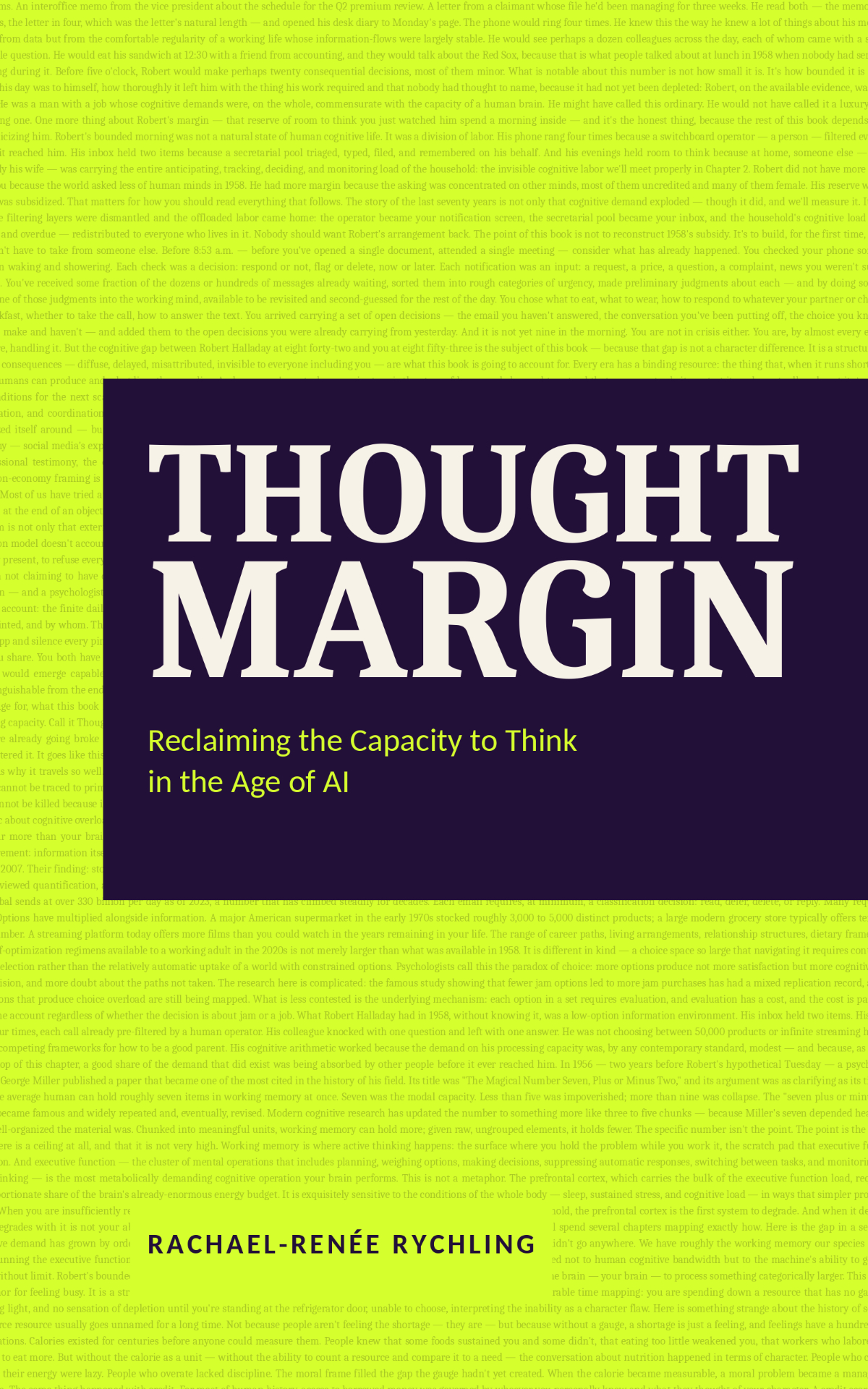
The binding scarcity of modern life is not time and not attention. It is cognitive processing capacity — the room a mind needs to judge well, create, reflect, and be present. Thought Margin treats that capacity as a household account, with withdrawals, deposits, debt, and a balance, and gives the reader a gauge, a ledger, and a redesign. Along the way it examines how AI changes the shape of the account: answers get cheap, and margin becomes what makes your questions good.
Available on Amazon.
Contents
Each chapter has a two-page "essentials" summary you can download for personal use — the argument, the moves, and the AI thread on one printable spread.
Part I — Name the scarcity, and take a reading
Part II — Open the books
Part III — Rebuild
A note on the people in this book
Every named person is an invented composite, assembled from documented patterns and flagged as such where they first appear. The one person in the book who is not invented is the author.
A note on evidence
Famous statistics are checked against the studies that did or didn't produce them. Contested science is named as contested. The author's inferences are flagged as inferences in the notes.